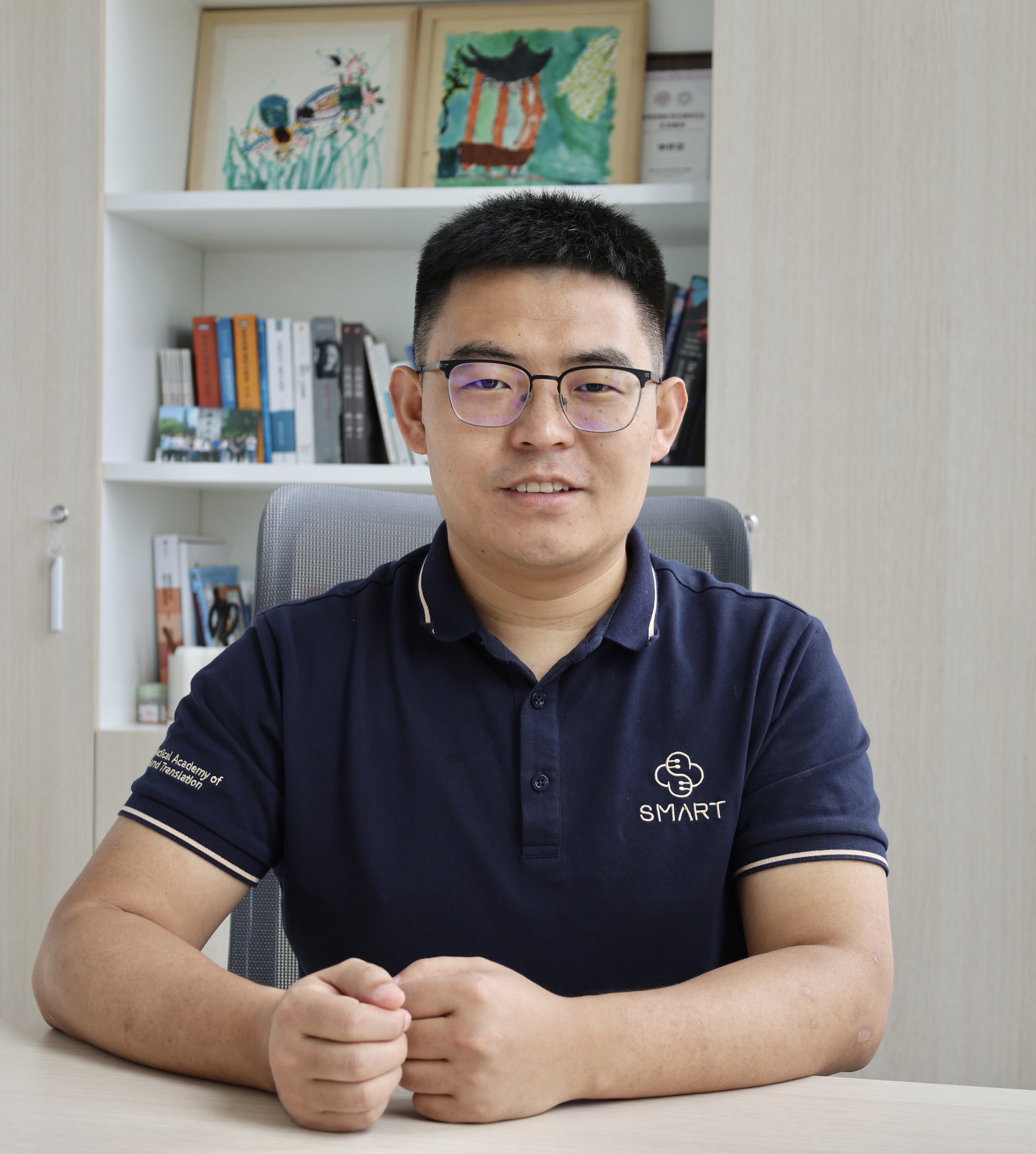
Dr. Huaizong Shen has joined the Institute of Bio-Architecture and Bio-Interactions (IBABI) at the Shenzhen Medical Academy of Research and Translation (SMART) as a full-time Principal Investigator and Deputy Director, and has established the Laboratory of Structural Biology and Artificial Intelligence.
Dr. Shen received his bachelor's degree from the School of Life Sciences, Shandong University (2008–2012), and his Ph.D. from the School of Life Sciences, Tsinghua University (2012–2017), followed by postdoctoral research at the School of Medicine, Tsinghua University (2017–2019). In 2019, Dr. Shen joined the School of Life Sciences at Westlake University as a Distinguished Investigator and Ph.D. advisor, before officially joining SMART in June 2026. Dr. Shen is a recipient of the National Talent Program and has served as the principal investigator or key contributor for multiple projects under the National Key R&D Program of China and the National Natural Science Foundation of China.
Dr. Huaizong Shen has long been engaged in structural biology studies of key drug targets, with a particular focus on ion channels, and has promoted the innovative application of artificial intelligence algorithms in cryo-electron microscopy data processing and structure determination.
One research direction in Dr. Shen's lab is focused on investigating the structural mechanisms and functional regulation of important membrane transport proteins, which leads to a series of representative achievements. Dr. Shen's group elucidated the molecular mechanism by which the deafness-associated ion channel KCNQ4 is modulated by small-molecule drugs (Molecular Cell, 2021), resolved the heteromeric assembly and subthreshold activation mechanisms of the human M-channel composed of KCNQ2 and KCNQ3 (Vita, 2026), reported the transport mechanisms and evolutionary conservation of human and yeast phosphate exporters XPR1 (Cell Research, 2025; Cell Discovery, 2026), and systematically investigated the structural basis of important plant potassium transport proteins, including AKT1, HKT, and HAK5 (Plant Communications, 2025; Nature Plants, 2024; LTS preprint, 2026). Together, these studies have deepened our understanding of the working mechanisms of membrane transport proteins, including ion channels, and have provided important clues for elucidating disease mechanisms and developing therapeutic strategies.
The other research direction of the lab is methodological innovation. Dr. Shen's group has actively explored new avenues for AI-enabled structural biology. The team developed Cryo-IEF, the first artificial intelligence foundation model for cryo-EM image processing (Nature Methods, 2025), and established CryoWizard, a fully automated workflow for cryo-EM structure determination. Its data-processing capability has reached a level comparable to that of expert structural biologists, substantially lowering the barrier to entry for cryo-EM analysis. To date, the relevant algorithms have been downloaded and used more than 19,000 times.
In addition, the group developed CryoDECO, an algorithm that leverages foundation-model priors to overcome optimization bottlenecks in current AI-based methods for heterogeneity classification in cryo-EM data. CryoDECO greatly improves the analysis of datasets with extreme compositional and complex conformational heterogeneity (LTS preprint, 2026). Building on this algorithm, the group has proposed and advanced the paradigm of Panoramic Structural Biology, exploring the use of AI-based sorting to reduce the dependence of structural biology on complex biochemical purification procedures.
2025 First Prize, Natural Science Award, Ministry of Education of China
2025 Outstanding Teacher of the Year 2025, Hangzhou Municipal Education Bureau System
2019 Outstanding Postdoctoral Fellow, Tsinghua University (university-level award; 10 selected through competitive evaluation)
2017 Distinguished Scholar, Advanced Innovation Center for Structural Biology, Tsinghua University
The Laboratory of Structural Biology and Artificial Intelligence (Shen Lab), is dedicated to integrating life science disciplines, including biochemistry, structural biology, and cell biology, with cutting-edge artificial intelligence technologies to advance mechanistic studies of biological molecules, drive technological innovation, and facilitate rational drug design. The lab focuses on elucidating the molecular mechanisms of key drug targets, particularly ion channels and membrane receptors, and on developing AI-driven approaches for rational drug design. In parallel, the lab leverages advanced AI algorithms to empower and accelerate structural biology research, promoting the development of cryo-electron microscopy toward higher throughput, greater intelligence, and broader accessibility, with the goal of establishing it as a general-purpose research tool in the life sciences.
1. Yang Yan*, Yanwanyu Xi*, Shiqi Fan, Yifei Wang, Ziyun Tang, Fajie Yuan#, Huaizong Shen#. CryoDECO: Deconstructing Extreme Compositional and Conformational Heterogeneity in Cryo-EM via Foundation Model Priors. https://doi.org/10.65215/LTSpreprints.2025.12.30.000075. (*co-first authors, #correspondence author)
2. Yifei Wang*, Hui Yang*, Yannan Qu*, Junnan Li*, Wenxin Hou, Guanglei Xie, Kun Wu, Xi Wang, Huaiyu Yang#, Huaizong Shen# (2026). Structural basis for heteromeric assembly and subthreshold activation of human M-channel. Vita. (*co-first authors, #correspondence author)
3. Hui Yang*, Yuechan Wang*, Chenxi Yue*, Xinran Li, Yifei Wang, Ye Yu#, Huaizong Shen# (2026). Structural insights into the gating mechanism of the fission yeast phosphate exporter SpXpr1. Cell Discovery. (*co-first authors, #correspondence author)
4. Yang Yan*, Shiqi Fan*, Fajie Yuan#, Huaizong Shen# (2025). A comprehensive foundation model for cryo-EM image processing. Nature Methods. (*co-first authors, #correspondence author)
5. Yifei Wang*, Yuechan Wang*, Hui Yang*, Ao Li, Dan Ma, Huaizong Shen# (2025). Structural basis of phosphate export by human XPR1. Cell Research. (*co-first authors, #correspondence author)
6. Zijie Zheng*, Yannan Qu*, Jiexin Chen*, Yuyue Tang, Dongliang Liu#, Zhuo Huang#, Huaizong Shen# (2025). AtKC1 inhibits AKT1 activation via its amino-terminal inhibitory domain. Plant Communications. (*co-first authors, #correspondence author)
7. Xiaohui Wang*, Xiaoshuai Shen*, Yannan Qu*, Heng Zhang*, Chu Wang*, Fan Yang#, Huaizong Shen# (2024). Structural insights into ion selectivity and transport mechanisms of Oryza sativa HKT2;1 and HKT2;2/1 transporters. Nature Plants. (*co-first authors, #correspondence author)
8. Zhaowei Wu*, Dongliang Liu*, Deng Pan*, Haopeng Yu, Jin Shi, Jiacheng Ma, Wenhan Fu, Zhipeng Wang, Zijie Zheng, Yannan Qu, Fan Li, Weizhong Chen, Xingxu Huang, Huaizong Shen#, Quanjiang Ji# (2023). Structure and engineering of miniature Acidibacillus sulfuroxidans Cas12f1. Nature Catalysis. (*co-first authors, #correspondence author)
9. Gaoxingyu Huang*, Dongliang Liu*, Weipeng Wang*, Qiurong Wu, Jiaofeng Chen, Xiaojing Pan, Huaizong Shen#, Nieng Yan# (2022). High-resolution structures of human Nav1.7 reveal gating modulation through α-π helical transition of S6IV. Cell Reports. (*co-first authors, #correspondence author)
10. Tian Li*, Kun Wu*, Zhenlei Yue*, Yifei Wang, Fan Zhang, Huaizong Shen# (2021). Structural Basis for the Modulation of Human KCNQ4 by Small-Molecule Drugs. Molecular Cell. (*co-first authors, #correspondence author)
11. Huaizong Shen*, Dongliang Liu*, Kun Wu, Jianlin Lei, Nieng Yan# (2019). Structures of human Nav1.7 channel in complex with auxiliary subunits and animal toxins. Science, eaaw2493. (*co-first authors, #correspondence author)
12. Xiaojing Pan*, Zhangqiang Li*, Qiang Zhou*, Huaizong Shen*, Kun Wu*, Xiaoshuang Huang, Jiaofeng Chen, Juanrong Zhang, Xuechen Zhu, Jianlin Lei, Wei Xiong, Haipeng Gong, Bailong Xiao, Nieng Yan# (2018). Structure of the human voltage-gated sodium channel Nav1. 4 in complex with β1. Science, eaau2486. (*co-first authors, #correspondence author)
13. Huaizong Shen*, Zhangqiang Li*, Yan Jiang*, Xiaojing Pan*, Jianping Wu, Ben Cristofori-Armstrong, Jennifer J. Smith, Yanni K. Y. Chin, Jianlin Lei, Qiang Zhou#, Glenn F. King#, Nieng Yan# (2018). Structural basis for the modulation of voltage-gated sodium channels by animal toxins. Science, eaau2596. (*co-first authors, #correspondence author)
14. Huaizong Shen*, Qiang Zhou*, Xiaojing Pan*, Zhangqiang Li*, Jianping Wu*, Nieng Yan# (2017). Structure of a eukaryotic voltage-gated sodium channel at near-atomic resolution. Science, 355(6328), eaal4326. (*co-first authors, #correspondence author)
15. Wei Peng*, Huaizong Shen*, Jianping Wu*, Wenting Guo, Xiaojing Pan, Ruiwu Wang, S.R.Wayne Chen#, Nieng Yan# (2016). Structural basis for the gating mechanism of the type 2 ryanodine receptor RyR2. Science, 354(6310), aah5324. (*co-first authors, #correspondence author)
talent@smart.org.cn
researcher@smart.org.cn
recruitment@smart.org.cn
graduate_office@smart.org.cn
graduate_admission@smart.org.cn
otl@smart.org.cn
smartfund@smart.org.cn
pr@smart.org.cn
Subscription successful! Thank you for following SMART.