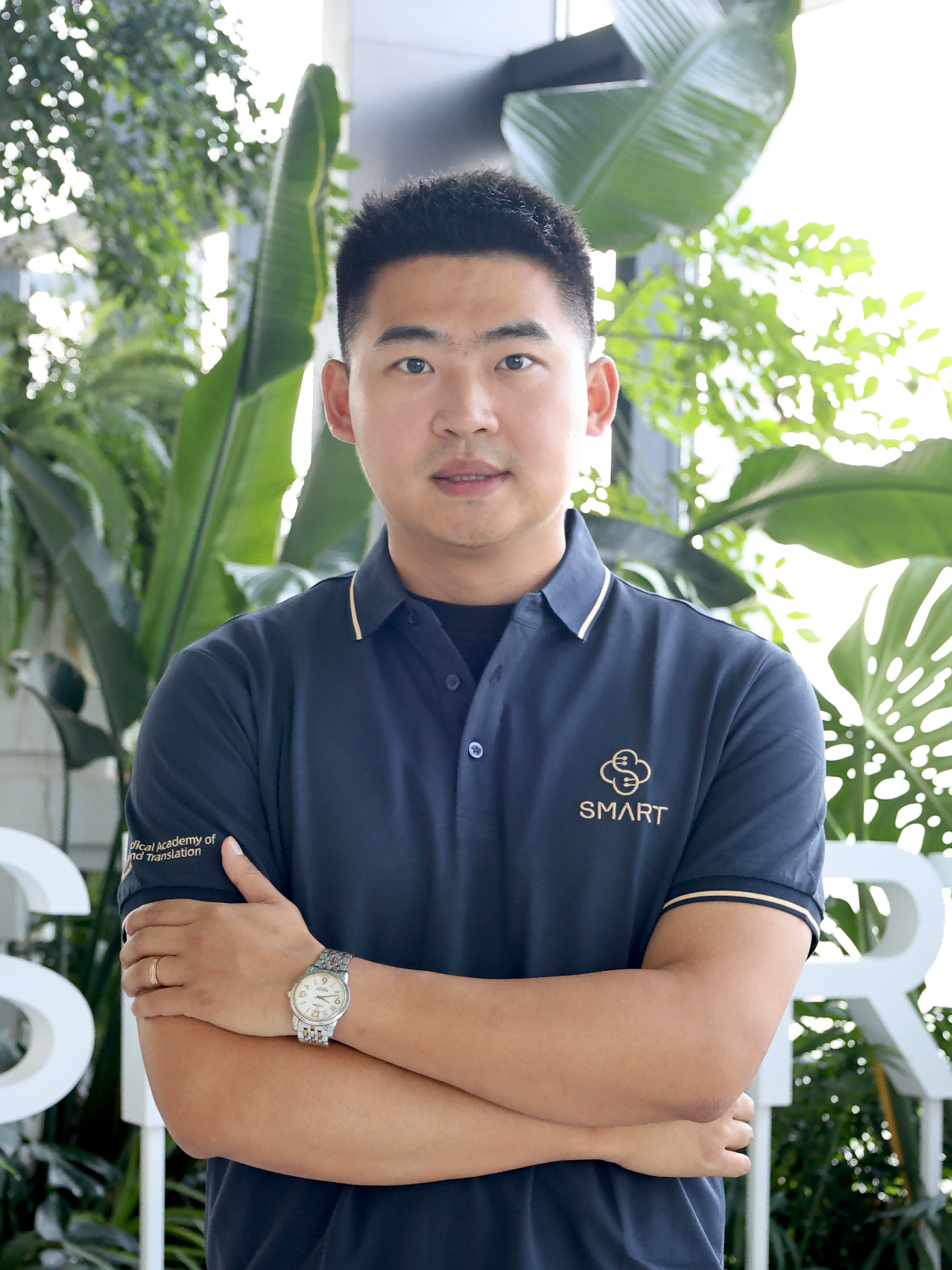
Dr. Hao Wu received a bachelor's degree from Jilin University in 2017 and a Ph.D. from Institute of Zoology, Chinese Academy of Sciences, in 2022. Dr. Wu completed postdoctoral training at the Institute of Zoology, Chinese Academy of Sciences, and UT Southwestern Medical Center before joining SMART in October 2026. The Lab’s research focuses on developing and utilizing stem cell-based models to investigate the developmental processes and regulatory mechanisms underlying early human embryonic and placental development. Dr. Wu has published 16 papers as first or corresponding author (including co-authorship in these roles) in international academic journals, including Nature Reviews Molecular Cell Biology, Nature Cell Biology, Cell Stem Cell, Nature Communications, and Nature Protocols.
Building on our own stem cell-based human embryo and placenta models, the Stem-cell Engineering for Embryonic Development (SEED) Lab focuses on key developmental events, particularly peri-implantation embryonic development, implantation, and placentation. Guided by scientific questions about cell fate determination and organization during early human embryo development, we integrate stem cell-based models, molecular biology techniques, and computational approaches to address important knowledge gaps. Our research is organized around three main areas:
1.Cell fate determination and morphogenesis in early embryonic development: We aim to generate stem cell-based embryo models that are physiologically relevant, standardized, scalable and capable of continuous developmental progression. We will explore their potential in basic and translational research, and use them to elucidate the mechanisms underlying cell fate determination and spatial organization in early embryos.
2.Human trophoblast development and function: We investigate cell fate determination, functional maturation, and spatial organization in the human trophectoderm and trophoblast. We also develop cell and organoid models with well-defined functions.
3.Dynamic processes and intercellular interactions in early embryo development: We integrate molecular labeling, lineage tracing, live-cell imaging, and other techniques into stem cell-based models to track cell fate diversification and spatial organization over time. By combining spatiotemporal omics with computational biology and AI approaches, we aim to elucidate how intercellular interactions regulate embryo morphogenesis.
1. Jiang X#, Wu H#, Zhao R#, Yu Y#, Xu Y#, Liu Q#, Zhang R#, Yu K, Zhu L, Zhang P, Wang Q, Chen C, Li T, Zhang W, Gao Y, Zou Y, Wu X, Qi L, Chen X, Su Y, Cheng Y, Zhang M, Xiao Z, Yan L, Cui L, Chen Z*, Wang H*, Zhai J*, Zhao H*. Spatiotemporal transcriptomic atlas of human embryos from gastrulation to early organogenesis. Nat Cell Biol. 2026 (Accepted)
2. Wu H#, Wu J*. Modeling monkey peri-gastrulation with stem cells. Vita. 2026. https://doi.org/10.15302/vita.2026.01.0006.
3. Wu H#, Wang H*. Progress in stem cell-based embryo models and their applications in developmental biology and biomedicine. Nat Rev Mol Cell Biol. 2026 Mar;27(3):178-193. doi: 10.1038/s41580-025-00942-0. Epub 2026 Jan 5. PMID: 41486301.
4. Yu X#, Wu H#, Su J#, Liu X, Liang K, Li Q, Yu R, Shao X, Wang H*, Wang YL*, Shyh Chang N*. Acetyl-CoA metabolism maintains histone acetylation for syncytialization of human placental trophoblast stem cells. Cell Stem Cell. 2024 Sep 5;31(9):1280-1297.e7. doi: 10.1016/j.stem.2024.07.003. Epub 2024 Jul 30. PMID: 39084220.
5. Xu Y#, Zhai J#, Wu H#, Wang H*. In vitro culture of cynomolgus monkey embryos from blastocyst to early organogenesis. Nat Protoc. 2024 Jul 25. doi: 10.1038/s41596-024- 01025-8. Epub ahead of print. PMID: 39060382.
6. Wu H#, Zhai J#, Wang H*. Unraveling the function of FGF signaling in human hypoblast specialization. Cell Stem Cell. 2024 Jul 5;31(7):945-946. doi: 10.1016/j.stem.2024.06.010. PMID: 38971145.
7. Xia S#, Yu D#, Wang Y, He B, Rong Y, Chen S, Xiao Z, Wang H, Wu H*, Yan L*. ISRIB faciitates the co-culture of human trophoblast stem cells and embryonic stem cells. Cell Prolif. 2024 Jan 12:e13599. doi: 10.1111/cpr.13599. Epub ahead of print. PMID: 38217296.
8. Wu H#, Huang XY#, Sun MX#, Wang Y#, Zhou HY#, Tian Y#, He B, Li K, Li DY, Wu AP, Wang H*, Qin CF*. Zika virus targets human trophoblast stem cells and prevents syncytialization in placental trophoblast organoids. Nat Commun. 2023 Sep 8;14(1):5541. doi: 10.1038/s41467-023-41158-0. PMID: 37684223; PMCID: PMC10491779.
talent@smart.org.cn
researcher@smart.org.cn
recruitment@smart.org.cn
graduate_office@smart.org.cn
graduate_admission@smart.org.cn
otl@smart.org.cn
smartfund@smart.org.cn
pr@smart.org.cn
Subscription successful! Thank you for following SMART.