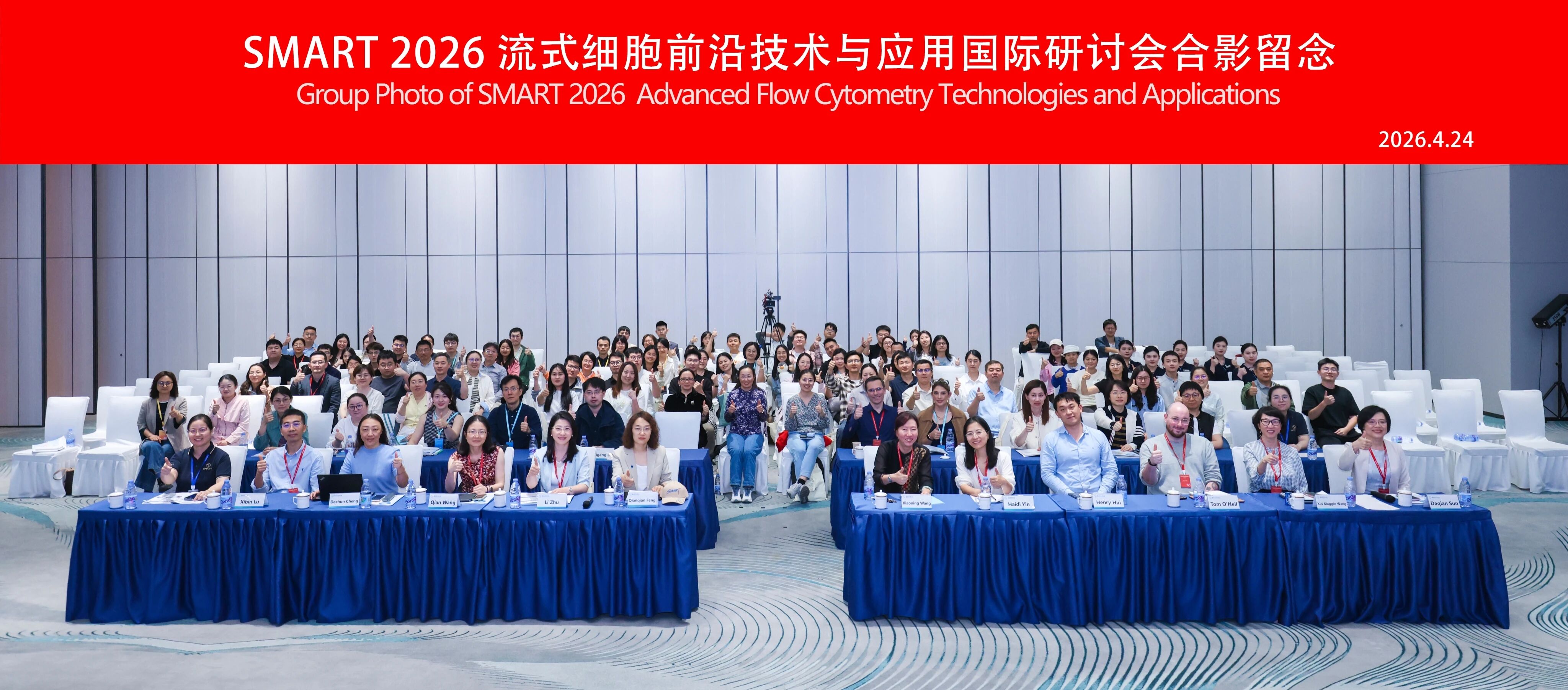
Guangming, Shenzhen, April 23–24, 2026 – The two-day "SMART 2026: Advanced Flow Cytometry Technologies and Applications", themed "Focusing on Core Technologies, Standardizing Application Criteria, Empowering Scientific Research Innovation", concluded successfully at Weiguang Life Science Park, Guangming Science City, Shenzhen. The symposium brought together nearly 200 senior experts and scholars from top universities, research institutes, hospitals and biotech companies around the world. Through intensive academic presentations and technical exchanges, participants deeply explored the latest advances in flow cytometry across immunology, oncology, and other cutting-edge application fields, and conducted thematic discussions on core technical support aspects including quality control and technological innovation, presenting a knowledge feast of academic research and flow cytometry technology for attendees from around the globe.
The agenda closely revolved around core and frontier areas of flow cytometry. On the first day, Researcher Liang Shan, Director of the Institute of Human Immunology at Shenzhen Medical Academy of Research and Translation (SMART), delivered the opening address and a keynote report on "Applications of Humanized Mouse Models in Human Immunology Research", noting that the model effectively simulates dynamic in vivo responses of the human immune system and provides a unique experimental window for dissecting immune mechanisms. Professor Limin Zheng from Sun Yat-sen University shared his latest findings on "Myeloid Cells and Tissue Microenvironment Remodeling", revealing the key role of myeloid cells in tumor immune regulation and offering new ideas for cancer immunotherapy. Subsequently, Researcher Hanjie Li from Shenzhen Institutes of Advanced Technology, Chinese Academy of Sciences, presented "Development, Differentiation and Functions of Human Immune Cells"; the human immune system development atlas created by his team was named one of the "Top 10 Domestic Science and Technology News of 2023" by Science and Technology Daily. Professor Xiaomei Yan from Xiamen University introduced "Advances in Extracellular Vesicle Analysis: Nano-Flow Cytometry for Fundamental Research and Biomedical Applications" and the global application achievements of her self-developed nFCM platform, which reaches single-particle sensitivity and provides a powerful tool for extracellular vesicle research. Professor Xunbin Wei from Peking University demonstrated the innovative technology of "Non-invasive Monitoring by in vivo Flow Cytometry With AI Breaks the Bottleneck of Circulating (Tumor) Cell Detection", enabling real-time dynamic monitoring of circulating tumor cells and expected to advance early tumor screening and efficacy assessment. Shuai Chu, Associate Chief Technologist at Nanfang Hospital, Southern Medical University, shared "Innovative Applications and Standardization of Clinical Flow Cytometry", combining clinical practical value with cutting-edge perspectives.
International experts also made outstanding contributions, with many highlights. Dr. Tom O’Neil from the Westmead Institute for Medical Research (Australia) gave an excellent talk on "Making the Most of Spatial: Unravelling Immune Interactions in HIV Transmission and Crohn's Disease", revealing the great potential of spatial multi-omics in infection and inflammation research. Dr. Henry Hui from the University of Western Australia introduced the international patented technology of "Immuno-flowFISH: Precision Single-Cell Diagnostics for Blood Cancers by Imaging Flow Cytometry", fully demonstrating the unique advantages of imaging flow cytometry in simultaneous capture of single-cell morphology and fluorescence signals. Professor Jingjing Zhao from Huazhong University of Science and Technology presented breakthrough progress in "Diffractive-Optics-Based Structured Illuminations in Biomedical Microscopy: Imaging Flow Cytometry and Optical Coherence Tomography"; this technology achieves super-resolution structured illumination via diffractive optical elements, significantly improving the spatial resolution of imaging flow cytometry and the imaging depth of OCT. Dr. Rui Gardner from Memorial Sloan Kettering Cancer Center deeply discussed "Building Spectral Backbone Panels for Immune Surveillance in Normal and Complex Tissues", effectively improving the construction efficiency of high-dimensional spectral flow cytometry panels and cross-laboratory comparability. One exciting report followed another. Dr. Xin Maggie Wang from the Westmead Institute for Medical Research (Australia) presented "Integrating Core Facilities into End-to-End Pipelines to Maximise Research Productivity", sharing international cutting-edge experience from the perspective of core facility integration management. Ms. Wei Cai, Product Manager at Cytek Biosciences, spoke on "Chasing the Light, a New Ecosystem Accelerates Cutting-edge Exploration Journey", outlining the industrial blueprint of full-spectrum flow cytometry.
The next day, the symposium shifted its focus to technical standardization and diversified application scenarios. Dr. Haidi Yin, Deputy Director of the Bio-Tech Center at SMART, gave a keynote introduction to the center’s core support facilities. Dr. Henry Hui and Ms. Qianqian Feng, Deputy Director of the Center of Biomedical Analysis and Supervisor of Core Facility at Tsinghua University, started from cutting-edge applications of imaging flow cytometry and presented complete solutions for image mining. Ms. Xiaoning Wang, Flow Cytometry Core Lab Manager at the National University of Singapore, and Dr. Dechun Cheng, Head of the Biochemistry Core at Shenzhen Bay Laboratory, delivered in-depth reports on cutting-edge applications of nano-flow cytometry, systematically demonstrating the unique advantages of nano-flow cytometry in highly sensitive characterization of biological nanoparticles such as extracellular vesicles, viral vectors and nanomedicines. Ms. Ruirui Xiang, Product Application Manager at Agilent Technologies (China), systematically explained “Spectral Flow Cytometry for High-Dimensional Analysis: Principles, Benefits, and Complex Sample Practice”. Mr. Zhigang Liu, Application Manager at Becton Dickinson Bioscience (Shanghai), shared “Development and Application of High-Dimensional Flow Cytometry and Novel Fluorescent Dyes”. The symposium not only discussed technical standards but also covered end-to-end considerations from sample preparation to data analysis, providing systematic solutions to enhance the rigor and efficiency of scientific research.
Notably, many experts reached a broad consensus on “standardization” and “data reproducibility”. Dr. Daqian Sun, Head of the Flow Cytometry Core Facility at SMART, and Dr. Qian Wang, an engineer at the University of Science and Technology of China, conducted a training session on Spectral Unmixing and Quality Control, systematically explaining the principles of spectral unmixing and key quality control steps, with in-depth case analyses. Dr. Rui Gardner and Dr. Li Zhu from Tongji Hospital, Tongji Medical College, Huazhong University of Science and Technology, jointly guided a workshop on high-dimensional spectral panel design, progressing stepwise from theory to practice. Dr. Tom O’Neil and Dr. Shixin Ma from SMART jointly delivered a lecture on A Practical Guide to Handling Cytometry Data: End-to-End Analysis Considerations, helping participants bridge the key steps from raw data to scientific conclusions. Dr. Xin Maggie Wang and Dr. Xibin Lu, Head of the Flow Cytometry Platform at Southern University of Science and Technology, presented a profound report on “Quality Control and Standardisation in Flow Cytometry”, systematically elaborating how to ensure high-quality and reproducible data output.
The symposium was co-organized by experts from Shenzhen Medical Academy of Research and Translation (SMART) and Tsinghua University. It was held in Shenzhen Guangming Science City, aiming to leverage the unique advantages of this pioneering area of the Guangdong-Hong Kong-Macao Greater Bay Area Comprehensive National Science Center to establish an international high-end facility for flow cytometry technology exchange and core facility management collaboration.
The venue was packed, and the interactive sessions were lively. Participants expressed that the content was both theoretically profound and extremely practical, of great value for solving technical bottlenecks in daily research, understanding the latest international developments, and establishing cross-institutional collaboration networks.
The success of this symposium not only demonstrated the academic vitality of Guangming Science City as a cradle of original innovation but also provided a platform for in-depth dialogue among experts and scholars in the field of flow cytometry both domestically and internationally. Looking ahead, with the continuous holding of such high-level exchange activities, the standardization, innovative application and development of flow cytometry technology in China will be further promoted, injecting new and powerful momentum into life science and medical research.
talent@smart.org.cn
researcher@smart.org.cn
recruitment@smart.org.cn
graduate_office@smart.org.cn
graduate_admission@smart.org.cn
otl@smart.org.cn
smartfund@smart.org.cn
pr@smart.org.cn
Subscription successful! Thank you for following SMART.