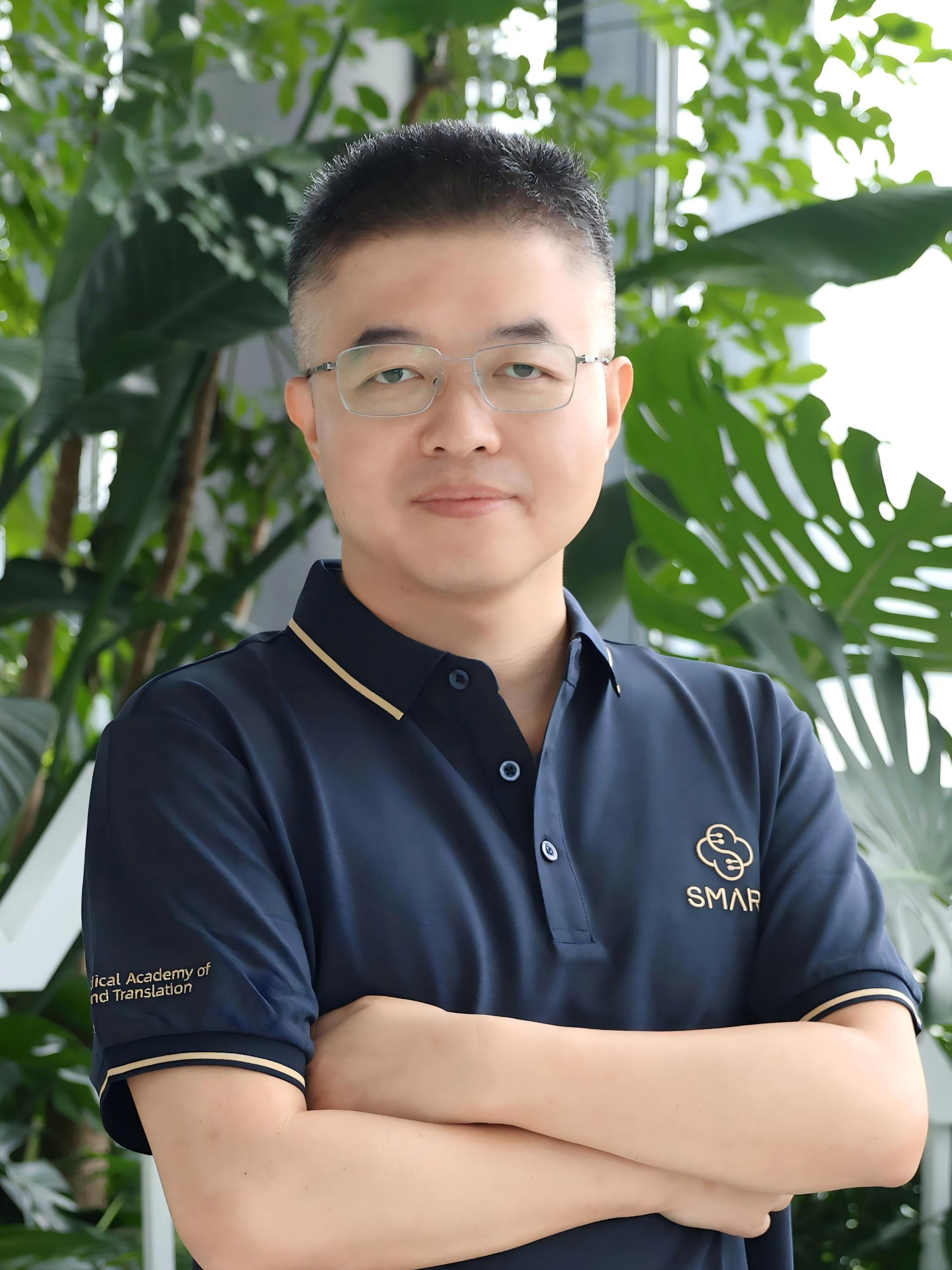
Principal Investigator
DC Biology and Immunotherapy
chengliang@smart.org.cn
Lirong Tan (tanlirong@smart.org.cn)
Dr. Liang Cheng's laboratory focuses on two interconnected frontiers in human immunology: dendritic cell (DC)-mediated immune tolerance and immunotherapy for chronic diseases — with a translational vision to convert fundamental immunological discoveries into clinically actionable precision strategies.
(1) DC-Mediated Immune Tolerance
We are dedicated to discovering new human DC subsets and deciphering their roles in immune balance and therapeutic targeting. Our discovery of DC2hm—a homeostatic mature DC subset that enforces peripheral tolerance through self‑antigen presentation and Treg induction—has reshaped the conceptual landscape of human immune tolerance. We are now dissecting DC2hm's functions across autoimmunity, inflammation, and cancer, while also pioneering cellular reprogramming to create next‑generation DC‑based therapies for autoimmune diseases, chronic infections, and malignancies.
(2) HIV/AIDS functional cure
We combine clinical samples, mechanistic studies, and humanized mouse models to uncover HIV immunopathogenesis and develop novel immunotherapies. Our earlier work defined the pDC–IFN–metabolic axis as a key driver of HIV persistence and T‑cell exhaustion. We are now engineering first‑in‑class biologics with a triple “reactivate–target–kill” function to clear latent reservoirs, alongside strategies to preserve virus‑specific T‑cell stemness—offering a dual‑pronged approach for long‑term immune control and a functional cure.
Dr. Cheng has long been dedicated to human dendritic cell (DC) immunology and immunotherapeutic strategies for chronic infectious diseases. His research has yielded a series of innovative contributions to peripheral immune tolerance and HIV cure strategies: Discovered and defined a novel dendritic cell subset—homeostatic mature DC2 (DC2hm)—that regulates human peripheral tolerance (Immunity, 2026);Elucidated the pDC-IFN-immunometabolic signaling axis as a core driver of HIV persistence and immune exhaustion (Cell Mol Immunol, 2026; JCI series);Developed a novel HIV cure strategy that integrates "activation-targeting-elimination" of the latent HIV reservoir (Patents 2024a/2024b).
2026 - 至今Principal Investigator, Shenzhen Medical Academy of Research and Translation (SMART)
2020 - 2026Principal Investigator, Medical Research Institute, Wuhan University
2018 - 2020Research Assistant Professor, UNC-Chapel Hill, US
2014 - 2018Research Associate, UNC-Chapel Hill, US
2011 - 2014Postdoctoral Research Associate, UNC-Chapel Hill, US
2006 - 2011Ph.D., Cellular Immunology, Institute of Biophysics, Chinese Academy of Sciences
2002 - 2006B.S., Biology, Wuhan University
Third Prize, Chinese Medical Science and Technology Award (2022
Hubei Provincial Hundred Talents Program (Innovative Talent) (2021)
CROI-2018 New Investigator Scholarship (2018)
1. M Lu#, R Han#, H Yang#, L Yang#, Q Zhao, J Wang, Z Yu, N Liu, Y Xu, F Luo, Y Mu, H Wang, F Luo, Z Wang, M Zhou, K Lin, H Chen, H Chen, W Zhou, X Chen, H Li, R Chen, Q Zhang*, L Wang*, L Cheng*. Homeostatic Maturation Programs Drive Human cDC2s into a Tolerogenic State. Immunity 2026 May 12;59(5):1201-1220.e13.
2. Y Xu, H Yang, L Yang, Q Zhang, L Cheng*. Febrile-Range Temperature Selectively Limits Sustained pDC-Derived IFN-α via Attenuation of STAT1-Dependent Feedback Signaling. Cell Insight 2026 (Available online 24 June 2026, 100344).
3. L Cheng*, G Li, F Luo, W Bi, M Lu, N Liu, Q Zhao, R Han, H Wang, H Yang, J Ma, W Hu, H Yu, W Hou, Y Xiong, N Goonetilleke, RB Jones, L Su*. Persistent IFN-I Signaling Inhibits Mitochondrial Oxidative Metabolism in CD8+ T Cells during HIV-1 Infection under cART. Cellular & Molecular Immunology 2026 May;23(5):534-545.
4. F Luo#, Y Cao#, N Liu, X Wang, W Hu, Y Yan, X Xie, D Jiang, Y Xu, J Wang, H wang, Z Yu, P Qian, S Wan, Z Liu, Y Gong, T Chen, S Song, Y Xiong, X Tang,
L Li, L Wang, H Yu*, L Cheng*. Synchronized latency reversal and immune clearance by a multifunctional fusion protein enables HIV-1 reservoir reduction. Molecular Therapy 2026 Jul 29:S1525-0016(26)00669-6.
5. R Han, H Yu, G Li, L Su*, L Cheng*. Persistent Type I Interferon Signaling Impairs Innate Lymphoid Cells During HIV-1 Infection Under Suppressive ART. Viruses. 2025 Aug 8;17(8):1099.
6. L Cheng*, H Yu, J Wrobel, G Li, P Liu, Z Hu, X Xu, L Su*. Identification of pathogenic TRAIL-expressing innate immune cells during HIV-1 infection in humanized mice by scRNA-Seq. JCI Insight. 2020 5(11):e135344.
7. L Cheng, Q Wang, G Li, J Ma, H Yu, F Yasui, Z Zhang, S Zurawski, G Zurawski, Y Levy*, L Su*. TLR3 agonist/CD40-targeting vaccination induces T cell response and reduces HIV-1 reservoirs. The Journal of Clinical Investigation. 2018 128(10):4387-4396.
8. L Cheng#, J Ma#, J Li#, D Li, G Li, F Li, Q Zhang, H Yu, F Yasui, C Ye, L-C Tsao, Z Hu, L Su*, L Zhang*. Blocking type I interferon signaling enhances T cell recovery and reduces HIV-1 reservoirs. The Journal of Clinical Investigation. 2017 127(1), 269-279.
9. L Cheng*, H Yu, G Li, F Li, J Ma, J Li, L Chi, L Zhang*, L Su*. Type I Interferons Suppress Viral Replication but Contribute to T Cell Depletion and Dysfunction during Chronic HIV-1 Infection. JCI Insight. 2017 2(12): e94366.
10. Z Zhang#, L Cheng#, J Zhao#, G Li, L Zhang, W Chen, W Nie, N-J Reszka-Blanco, F-S Wang, L Su*. Plasmacytoid dendritic cells promote HIV-1-induced group 3 innate lymphoid cell depletion. The Journal of Clinical Investigation. 2015 125, 3692-3703.
11. L Cheng#, X Du#, Z Wang, J Ju, M Jia, Q Huang, Q Xing, M Xu, Y Tan, M Liu, P Du, L Su*, S Wang*. Hyper-IL-15 suppresses metastatic and autochthonous liver cancers by promoting tumor-specific CD8 T cell responses. Journal of Hepatology. 2014 61, 1297-1303.
We are currently recruiting assistant research fellows, outstanding postdoctoral fellows and research assistants who are aspiring to further their academic careers, both domestically and internationally. We warmly welcome talented individuals with a strong interest in DC immunology, HIV immunotherapy, tumor immunology, and related research fields to join us. Please visit: smart.org.cn/career/research-lab/1215.html
talent@smart.org.cn
researcher@smart.org.cn
recruitment@smart.org.cn
graduate_office@smart.org.cn
graduate_admission@smart.org.cn
otl@smart.org.cn
smartfund@smart.org.cn
pr@smart.org.cn
Subscription successful! Thank you for following SMART.