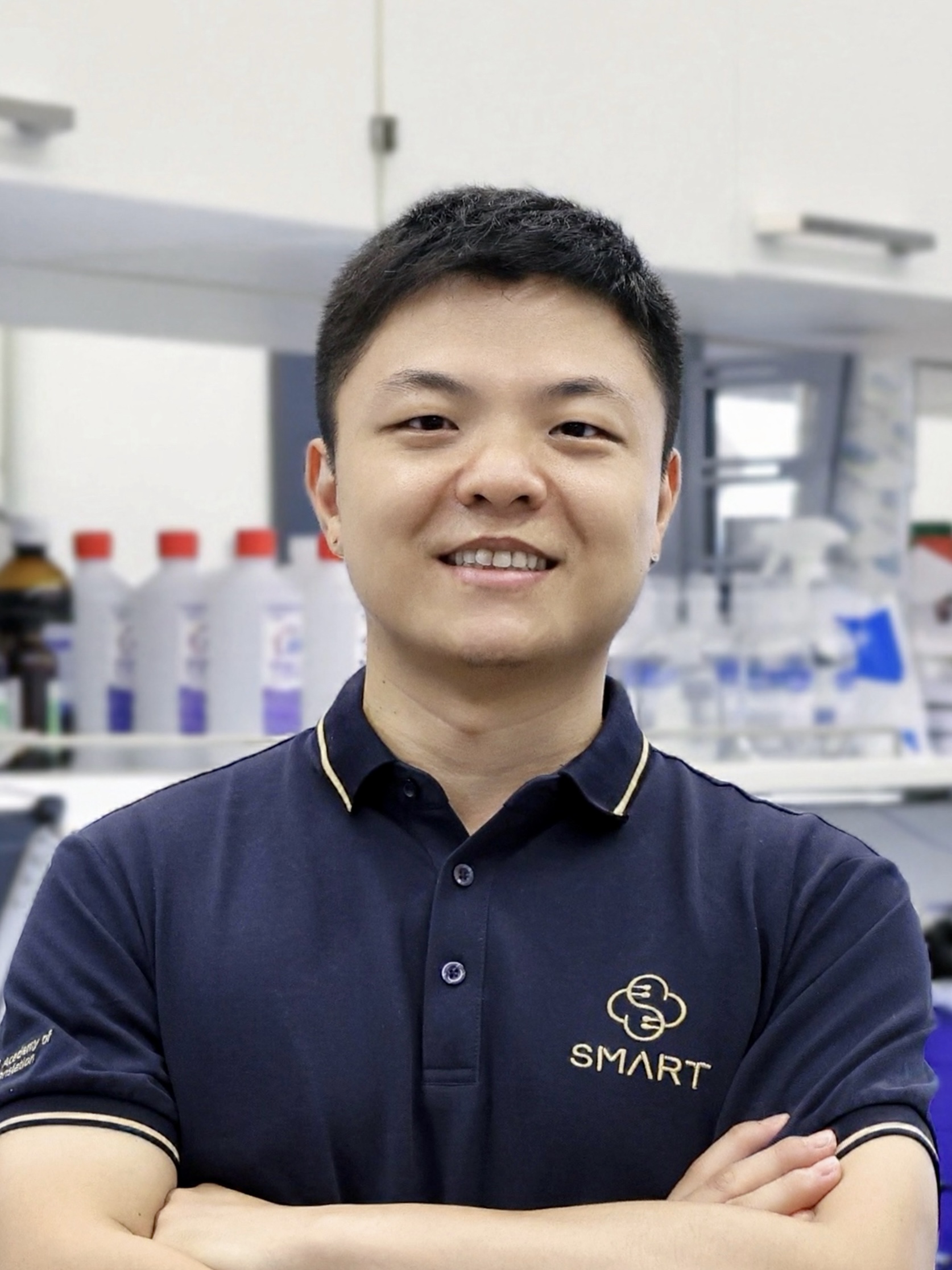
Junior Principal Investigator
Neurobiology
yezhiwen@smart.org.cn
Na Li (lina@smart.org.cn)
Understanding how the brain works is one of the defining scientific challenges of our time. With rapid advances in large-scale recording and artificial intelligence, neuroscience now stands at the edge of major breakthroughs. The Ye Lab follows a simple line of inquiry to uncover the brain's organizing principles: from tools, to decoding, to manipulation. By coupling new recording technologies with computational analysis and causal perturbation, we aim to progress from observing brain-wide neural activity to understanding and ultimately shaping the brain.
We focus on three directions:
(1) Exploring and building new brain-wide recording tools;
(2) Uncovering the rules of sensorimotor processing and learning, with a particular focus on cross-modality integration and the functional logic of rotating waves;
(3) Manipulating brain circuits causally to test mechanistic hypotheses and inform the treatment of brain disorders.
Dr. Ye's research focuses on sensorimotor processing, decision-making, and the mechanisms of sleep/wake regulation. Grounded in large-scale electrophysiology recording and imaging, the lab integrates optogenetics, brain-wide dynamics analysis, and computational modeling to study brain function across scales from single neurons to networks. His main contributions include: (1) leading the development of the next-generation high-density probe Neuropixels Ultra/HD (Neuron, 2025), and contributing to the development and testing of Neuropixels 2.0 and Neuropixels Opto; (2) discovering rotating waves that propagate across the cortical somatosensory body map, revealing their underlying ring-topology connectivity, and indicating their role in sensorimotor processing and decision-making (Science, 2026); and (3) characterizing the mechanisms of extrasynaptic GABAergic transmission and tonic inhibition (Nat. Commun., 2016), and dissecting how GABAergic and histaminergic systems regulate sleep and wakefulness (Neuron, 2015; J. Neurosci., 2016).
2026 - PresentJunior Principal Investigator, Institute of Neuromodulation and Cognition (INC), Shenzhen Medical Academy of Research and Translation (SMART)
2020 - 2026Postdoc, University of Washington (Seattle)
2015 - 2019Postdoc, The Francis Crick Institute (UK)
2014 - 2015Research Assistant, Imperial College London
2010 - 2015PhD, Imperial College London
2006 - 2010Bachelor of Science, Harbin Institute of Technology
2010–2015 UK–China Scholarship for Excellence
*co-first author †co-corresponding author
1. Ye Z†, Ladd A, MacKenzie N, Kolich L, Li AJ, Birman D, Bull MS, Daigle TL, Tasic B, Zeng H, Steinmetz NA†. Brain-wide topographic coordination of rotating waves. Science 392, eadx1369 (2026).
doi: 10.1126/science.adx1369
2. Ye Z*, Shelton AM*, Shaker JR, Boussard JM, Colonell J, Minavi S, … Steinmetz NA. Ultra-high-density Neuropixels probes improve detection and identification in neuronal recordings. Neuron 113, 3966–3982.e12 (2025). doi:10.1016/j.neuron.2025.08.030
3. Tran-Van-Minh A*, Ye Z*, Rancz E. Quantitative analysis of rabies virus-based synaptic connectivity tracing. PLOS ONE 18, e0278053 (2023). doi:10.1371/journal.pone.0278053
4. Ye Z, Yu X, Houston CM, Aboukhalil Z, Franks NP, Wisden W, Brickley SG. Fast and slow inhibition in the visual thalamus is influenced by allocating GABA_A receptors with different γ subunits. Frontiers in Cellular Neuroscience 11, 95 (2017). doi:10.3389/fncel.2017.00095
5. Jager P*, Ye Z*, Yu X, Zagoraiou L, Prekop HT, Partanen J, Jessell TM, Wisden W, Brickley SG, Delogu A. Tectal-derived interneurons contribute to phasic and tonic inhibition in the visual thalamus. Nature Communications 7, 13579 (2016). doi:10.1038/ncomms13579
6. Uygun DS*, Ye Z*, Zecharia AY, Harding EC, Yu X, Yustos R, Vyssotski AL, Brickley SG, Franks NP, Wisden W. Bottom-up versus top-down induction of sleep by zolpidem acting on histaminergic and neocortex neurons. Journal of Neuroscience 36, 11171–11184 (2016). doi:10.1523/JNEUROSCI.3714-15.2016
7. Yu X*, Ye Z*, Houston CM, Zecharia AY, Ma Y, Zhang Z, Uygun DS, Parker S, Vyssotski AL, Yustos R, Franks NP, Brickley SG, Wisden W. Wakefulness is governed by GABA and histamine cotransmission. Neuron 87, 164–178 (2015). doi:10.1016/j.neuron.2015.06.003
8. Ye Z, McGee TP, Houston CM, Brickley SG. The contribution of δ subunit-containing GABA_A receptors to phasic and tonic conductance changes in cerebellum, thalamus and neocortex. Frontiers in Neural Circuits 7, 203 (2013). doi:10.3389/fncir.2013.00203
The Ye Lab is now recruiting Associate/Assistant Researchers, postdoctoral fellows, research assistants, a laboratory manager, and visiting students, across areas spanning neuroscience, computation neuroscience, machine learning, and mechanical/electronic/automation engineering. We warmly welcome early-career scholars with strong curiosity and a passion for research to join us. Please send application materials and reference letters to: systemsneuro@smart.org.cn
For more details, please visit: Recruitment in the Zhiwen Ye Lab.
talent@smart.org.cn
researcher@smart.org.cn
recruitment@smart.org.cn
graduate_office@smart.org.cn
graduate_admission@smart.org.cn
otl@smart.org.cn
smartfund@smart.org.cn
pr@smart.org.cn
Subscription successful! Thank you for following SMART.