Acute lymphoblastic leukemia (ALL) is the most common malignancy in children, with B-cell acute lymphoblastic leukemia (B-ALL) accounting for approximately 80% of cases. In recent years, advances in combination chemotherapy, molecular targeted therapy, and CAR-T cell therapy have substantially improved overall survival outcomes for B-ALL patients. However, many patients still experience treatment failure due to relapse or drug resistance. Growing evidence suggests that, in addition to genetic abnormalities within leukemia cells, the bone marrow microenvironment forms a "protective barrier" that plays a critical role in promoting leukemia progression and treatment resistance. Therefore, elucidating the interactions between leukemia cells and the bone marrow microenvironment is of great significance for identifying new therapeutic targets and improving long-term patient survival.
Cyclophilin A (CypA) is a highly conserved chaperone protein that has been extensively studied for its role in protein folding and immune regulation. Recent studies have shown that CypA is secreted extracellularly and functions as a cytokine-like mediator in inflammatory responses, immune regulation, and disease pathogenesis. Wenjun Liu's team has long investigated extracellular Cyclophilin A (eCypA) and has revealed its roles in pathogenic infections (Molecular Therapy, 2024) and autoimmune disorders (Journal of Autoimmunity, 2025; Molecular Therapy, 2026). However, it remained unclear whether eCypA contributes to B-ALL progression, which receptor mediates its signaling, and whether it has therapeutic potential.
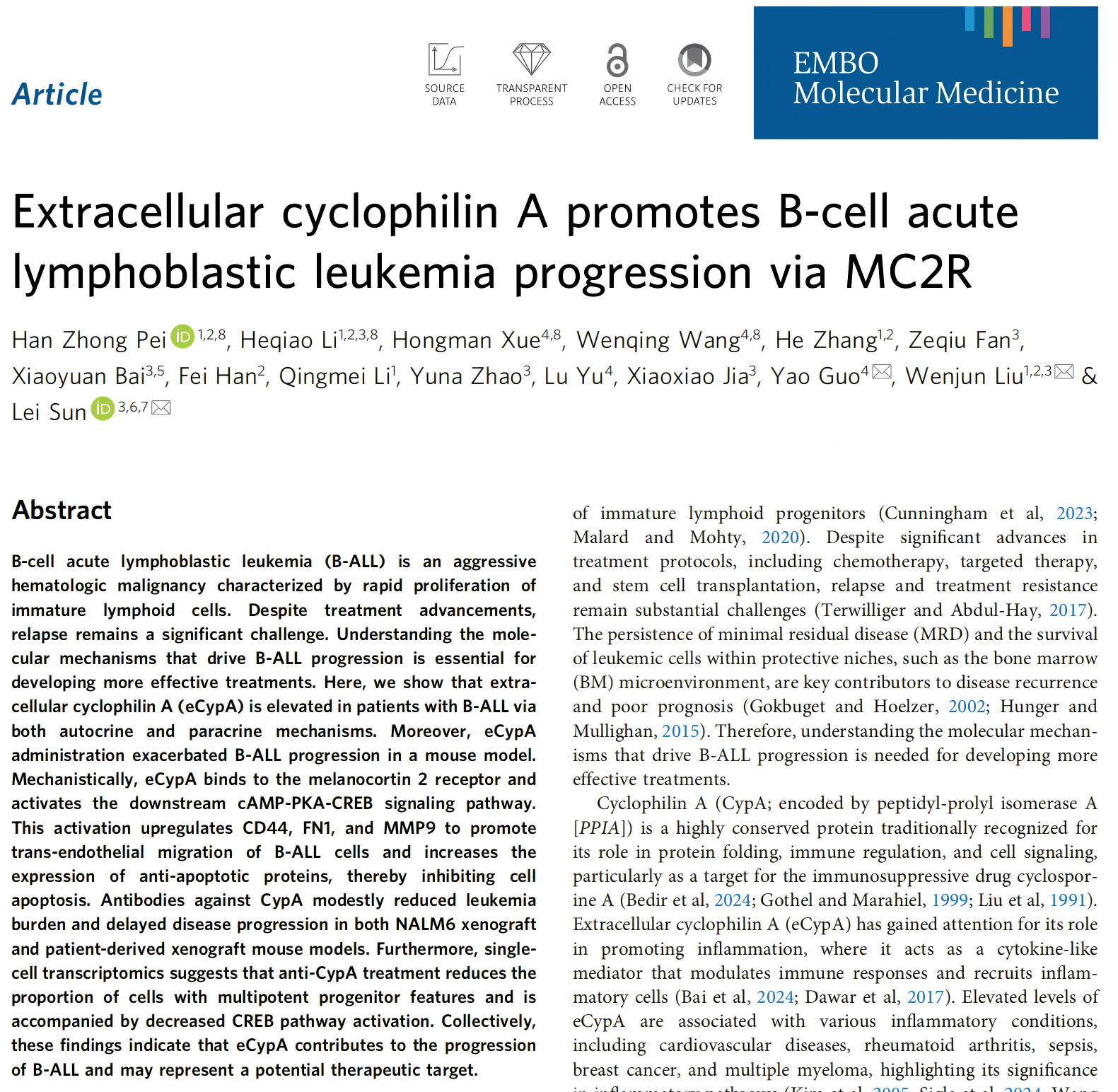
On June 10, 2026 (Beijing Standard Time), Wenjun Liu's team published an article entitled "Extracellular cyclophilin A promotes B-cell acute lymphoblastic leukemia progression via MC2R" in EMBO Molecular Medicine. This study reveals for the first time that eCypA binds to the novel receptor MC2R and activates the cAMP-PKA-CREB signaling pathway, thereby promoting B-ALL progression. Additionally, their anti-CypA monoclonal antibody significantly reduces leukemia burden and enhances chemosensitivity, offering a new theoretical foundation and a potential therapeutic strategy for B-ALL.
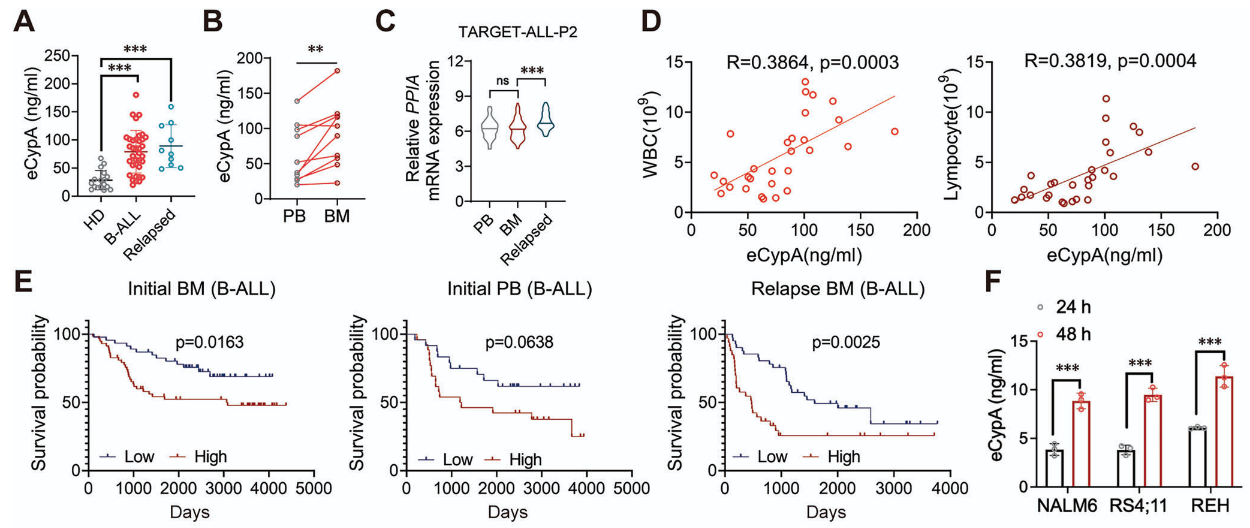
The team first demonstrated that eCypA levels are significantly elevated in both peripheral blood and bone marrow aspirates from B-ALL patients compared with healthy controls, and that relapsed patients also exhibit relatively high eCypA levels. Circulating eCypA levels are positively correlated with white blood cell counts, while analysis of the TARGET-ALL-P2 cohort showed that higher PPIA expression is associated with poorer patient survival. Further studies showed that leukemia cells not only actively secrete eCypA but also induce cells in the bone marrow microenvironment to continuously release eCypA, promoting a positive feedback within the microenvironment that contributes to leukemia progression, positioning eCypA as a key extracellular signaling molecule driving B-ALL progression.
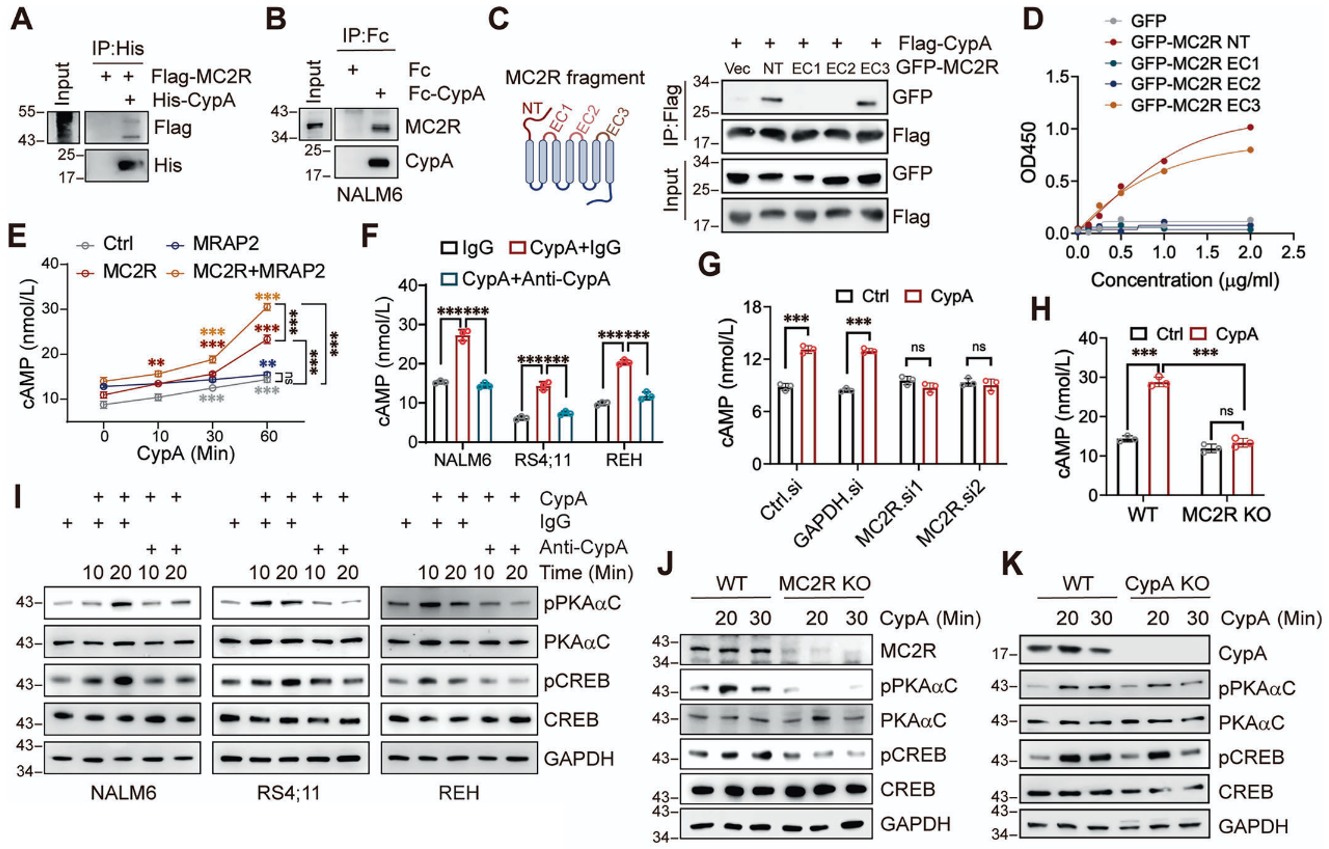
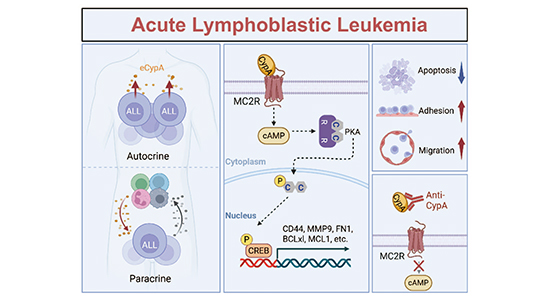
To elucidate the mechanism of eCypA action, the team identified melanocortin 2 receptor (MC2R) as a novel functional receptor for eCypA through proteomic screening and biochemical validation. Upon binding to MC2R, eCypA activates the cAMP-PKA-CREB signaling pathway, promoting transendothelial migration and enhancing anti-apoptotic activity in leukemia cells, whereas blocking MC2R abrogates this pathway. This study, for the first time, identifies the "eCypA-MC2R-CREB" signaling axis and elucidates a critical microenvironment-driven molecular mechanism underlying disease progression.
Building on this finding, the team further assessed the therapeutic potential of targeting eCypA. Their anti-CypA monoclonal antibody significantly reduced leukemia burden and extended survival in both cell line-derived and patient-derived xenograft (PDX) models, and demonstrated enhanced efficacy when combined with commonly used chemotherapy regimens. Single-cell transcriptomics further confirmed that blocking eCypA suppresses highly multipotent progenitor like leukemia cell subsets and significantly reduces CREB-driven transcriptional activity. These results indicate that targeting eCypA disrupts the leukemia microenvironment and synergizes with existing treatment regimens, offering a clinically translatable strategy for relapsed/refractory B-ALL.
Wenjun Liu (Researcher, Shenzhen Medical Academy of Research and Translation), Lei Sun (Project Researcher, Institute of Microbiology, Chinese Academy of Sciences), and Dr. Yao Guo (The Seventh Affiliated Hospital, Sun Yat-sen University) are co-corresponding authors. Dr. Hanzhong Pei and Dr. Heqiao Li from Wenjun Liu's team are co-first authors. This work was funded by the National Natural Science Foundation of China, the National Key Research and Development Program of China, and the Shenzhen Bay Laboratory Start-up Fund.
Wenjun Liu's team has long focused on the eCypA-mediated immune regulation and targeted therapeutic strategies, with a particular emphasis on major diseases such as infections, inflammation, autoimmune disorders, and tumors. The team has systematically investigated the biological functions of eCypA, its receptor recognition mechanisms, and therapeutic antibody development. In recent years, they have identified multiple novel functional receptors for eCypA, elucidated how eCypA contributes to inflammatory responses, pathogenic infections, and tumor microenvironment modulation, and established a platform for monoclonal antibody development against eCypA, continuously advancing the clinical translation of these basic discoveries. Moving forward, the team will continue to focus on mechanistic studies and drug development centered on eCypA-targeted therapeutics, further translating their findings into clinical applications.
talent@smart.org.cn
researcher@smart.org.cn
recruitment@smart.org.cn
graduate_office@smart.org.cn
graduate_admission@smart.org.cn
otl@smart.org.cn
smartfund@smart.org.cn
pr@smart.org.cn
Subscription successful! Thank you for following SMART.