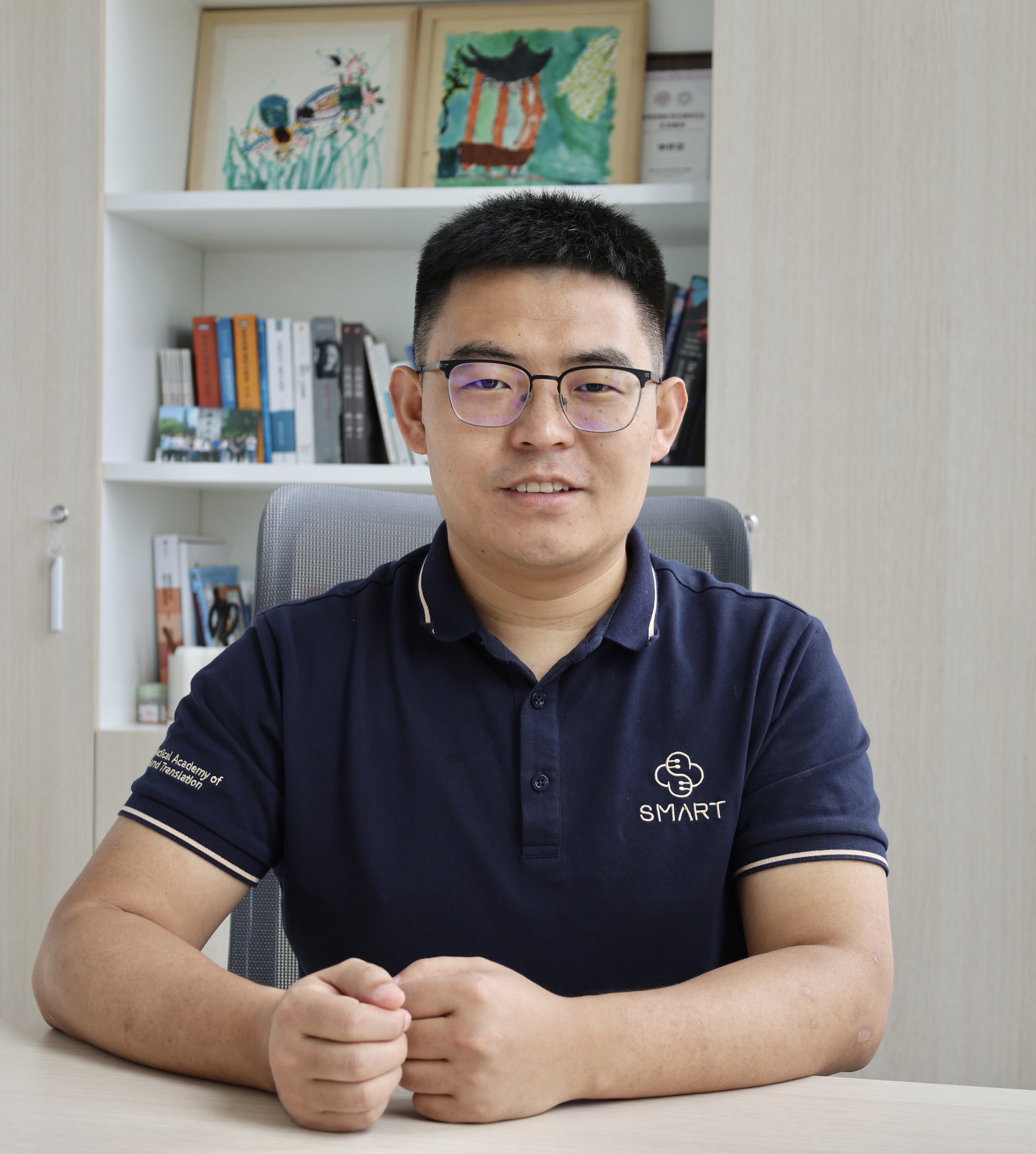
申怀宗博士现全职加入深圳医学科学院生物构造与互作研究所,任高级研究员、副所长,并组建结构生物学与人工智能实验室。
申怀宗博士本科就读于山东大学生命科学学院(2008-2012),博士就读于清华大学生命科学学院(2012-2017),随后在清华大学医学院开展博士后研究(2017-2019)。2019年申怀宗博士加入西湖大学生命科学学院担任特聘研究员、博士生导师,2026年6月加入深圳医学科学院。申怀宗博士是国家级人才项目入选者,主持与承担多项国家重点研发计划和国家自然科学基金委项目。
申怀宗博士长期从事以离子通道为代表的关键药物靶点的结构生物学研究,并推动人工智能算法在冷冻电镜数据处理与结构解析中的创新应用。
在重要膜转运蛋白的结构机理与功能调控研究方向,申怀宗课题组阐明了耳聋相关钾离子通道KCNQ4受到小分子药物调节的分子机理(2021 Mol. Cell),解析了人源M通道(由KCNQ2和KCNQ3组成)的异源组装与阈下激活机制(2026 Vita),报道了人源和酵母磷酸根外排蛋白XPR1的转运机理与进化保守性(2025 Cell Res., 2026 Cell Discov.),并系统研究了HKT、AKT1、HAK5等重要植物钾离子转运蛋白的结构基础(2024 Nat. Plants, 2025 Plant Commun., 2026 LTS preprint)。这些研究不仅深化了对离子通道等膜转运蛋白工作机制的理解,也为相关疾病机理解析和药物开发提供了重要线索。
另一方面,在方法学创新方向,申怀宗课题组积极探索AI赋能结构生物学研究的新路径。团队开发了首个针对冷冻电镜图像处理的人工智能基础模型Cryo-IEF(2025 Nat. Methods),并构建了全自动冷冻电镜结构解析流程CryoWizard,其数据处理能力已达到可比拟专家级结构生物学家的水平,大大降低了使用门槛。目前相关算法已被下载使用1.9万余次。此外,课题组发明的CryoDECO算法,利用基础模型先验,突破当前基于AI的冷冻电镜数据异质性分类算法存在的优化瓶颈,极大提高了算法对于存在极端组成与复杂构象异质性数据的处理能力(2026 LTS preprint)。基于该算法提出并推动“全景结构生物学”(Panoramic Structural Biology)范式发展,探索通过AI分选减少结构生物学对复杂生化纯化流程的依赖。
2025 教育部自然科学研究一等奖
2025 杭州市教育局系统2025年度优秀教师
2019 清华大学优秀博士后(校级差额10人)
2017 清华大学结构生物学高精尖创新中心卓越学者
申怀宗课题组(结构生物学与人工智能实验室)致力于整合生物化学、结构生物学、细胞生物学等生命学科与前沿人工智能技术,推动生命科学分子机理研究突破、前沿技术创新和理性药物设计。课题组重点关注关键药物靶点(特别是离子通道和膜受体)的分子机制研究和基于人工智能技术的理性药物设计;同时利用前沿AI算法赋能和加速结构生物学研究,促进冷冻电镜技术向更高通量、更智能化和更普及的方向发展,并推动其成为生命科学领域的通用研究手段。
具体而言,申怀宗课题组将重点推进以下研究方向:
一是面向关键药物靶点,解析离子通道和膜受体等的结构机理与功能调控机制,揭示其在生理和病理过程中的作用模式;
二是发展人工智能驱动的冷冻电镜数据处理与结构解析方法,构建自动化、智能化、高通量的数据处理与分析流程,推动其成为生命科学领域的通用研究手段;
三是推动结构生物学、人工智能技术和药物发现的深度融合,围绕重要疾病靶点开展基于分子结构与机理的理性药物筛选和设计,助力基础研究成果向生物医药创新转化。
1. Yang Yan*, Yanwanyu Xi*, Shiqi Fan, Yifei Wang, Ziyun Tang, Fajie Yuan#, Huaizong Shen#. CryoDECO: Deconstructing Extreme Compositional and Conformational Heterogeneity in Cryo-EM via Foundation Model Priors. https://doi.org/10.65215/LTSpreprints.2025.12.30.000075. (*co-first authors, #correspondence author)
2. Yifei Wang*, Hui Yang*, Yannan Qu*, Junnan Li*, Wenxin Hou, Guanglei Xie, Kun Wu, Xi Wang, Huaiyu Yang#, Huaizong Shen# (2026). Structural basis for heteromeric assembly and subthreshold activation of human M-channel. Vita. (*co-first authors, #correspondence author)
3. Hui Yang*, Yuechan Wang*, Chenxi Yue*, Xinran Li, Yifei Wang, Ye Yu#, Huaizong Shen# (2026). Structural insights into the gating mechanism of the fission yeast phosphate exporter SpXpr1. Cell Discovery. (*co-first authors, #correspondence author)
4. Yang Yan*, Shiqi Fan*, Fajie Yuan#, Huaizong Shen# (2025). A comprehensive foundation model for cryo-EM image processing. Nature Methods. (*co-first authors, #correspondence author)
5. Yifei Wang*, Yuechan Wang*, Hui Yang*, Ao Li, Dan Ma, Huaizong Shen# (2025). Structural basis of phosphate export by human XPR1. Cell Research. (*co-first authors, #correspondence author)
6. Zijie Zheng*, Yannan Qu*, Jiexin Chen*, Yuyue Tang, Dongliang Liu#, Zhuo Huang#, Huaizong Shen# (2025). AtKC1 inhibits AKT1 activation via its amino-terminal inhibitory domain. Plant Communications. (*co-first authors, #correspondence author)
7. Xiaohui Wang*, Xiaoshuai Shen*, Yannan Qu*, Heng Zhang*, Chu Wang*, Fan Yang#, Huaizong Shen# (2024). Structural insights into ion selectivity and transport mechanisms of Oryza sativa HKT2;1 and HKT2;2/1 transporters. Nature Plants. (*co-first authors, #correspondence author)
8. Zhaowei Wu*, Dongliang Liu*, Deng Pan*, Haopeng Yu, Jin Shi, Jiacheng Ma, Wenhan Fu, Zhipeng Wang, Zijie Zheng, Yannan Qu, Fan Li, Weizhong Chen, Xingxu Huang, Huaizong Shen#, Quanjiang Ji# (2023). Structure and engineering of miniature Acidibacillus sulfuroxidans Cas12f1. Nature Catalysis. (*co-first authors, #correspondence author)
9. Gaoxingyu Huang*, Dongliang Liu*, Weipeng Wang*, Qiurong Wu, Jiaofeng Chen, Xiaojing Pan, Huaizong Shen#, Nieng Yan# (2022). High-resolution structures of human Nav1.7 reveal gating modulation through α-π helical transition of S6IV. Cell Reports. (*co-first authors, #correspondence author)
10. Tian Li*, Kun Wu*, Zhenlei Yue*, Yifei Wang, Fan Zhang, Huaizong Shen# (2021). Structural Basis for the Modulation of Human KCNQ4 by Small-Molecule Drugs. Molecular Cell. (*co-first authors, #correspondence author)
11. Huaizong Shen*, Dongliang Liu*, Kun Wu, Jianlin Lei, Nieng Yan# (2019). Structures of human Nav1.7 channel in complex with auxiliary subunits and animal toxins. Science, eaaw2493. (*co-first authors, #correspondence author)
12. Xiaojing Pan*, Zhangqiang Li*, Qiang Zhou*, Huaizong Shen*, Kun Wu*, Xiaoshuang Huang, Jiaofeng Chen, Juanrong Zhang, Xuechen Zhu, Jianlin Lei, Wei Xiong, Haipeng Gong, Bailong Xiao, Nieng Yan# (2018). Structure of the human voltage-gated sodium channel Nav1. 4 in complex with β1. Science, eaau2486. (*co-first authors, #correspondence author)
13. Huaizong Shen*, Zhangqiang Li*, Yan Jiang*, Xiaojing Pan*, Jianping Wu, Ben Cristofori-Armstrong, Jennifer J. Smith, Yanni K. Y. Chin, Jianlin Lei, Qiang Zhou#, Glenn F. King#, Nieng Yan# (2018). Structural basis for the modulation of voltage-gated sodium channels by animal toxins. Science, eaau2596. (*co-first authors, #correspondence author)
14. Huaizong Shen*, Qiang Zhou*, Xiaojing Pan*, Zhangqiang Li*, Jianping Wu*, Nieng Yan# (2017). Structure of a eukaryotic voltage-gated sodium channel at near-atomic resolution. Science, 355(6328), eaal4326. (*co-first authors, #correspondence author)
15. Wei Peng*, Huaizong Shen*, Jianping Wu*, Wenting Guo, Xiaojing Pan, Ruiwu Wang, S.R.Wayne Chen#, Nieng Yan# (2016). Structural basis for the gating mechanism of the type 2 ryanodine receptor RyR2. Science, 354(6310), aah5324. (*co-first authors, #correspondence author)
申怀宗课题组长期招聘对膜蛋白机制研究、人工智能算法开发和AI for Science交叉研究感兴趣的研究系列人员、博士后、博士生和科研助理。欢迎具有生物化学、人工智能、药学和数学等相关研究背景的优秀人才加入,共同探索生命分子机器的工作机制,发展新一代智能化结构生物学与药物设计,推动基础生命科学研究与生物医药转化。简历投递邮箱:SnA@smart.org.cn。
talent@smart.org.cn
researcher@smart.org.cn
recruitment@smart.org.cn
graduate_office@smart.org.cn
graduate_admission@smart.org.cn
otl@smart.org.cn
smartfund@smart.org.cn
pr@smart.org.cn